Fire door regulations in the UK: what you need to know in 2026

Simon Edward • 21 August 2026

Here's a quick-reference guide to fire door regulations in the UK. Learn about key documents, fire safety ratings, testing frameworks and more.


Here's a quick-reference guide to fire door regulations in the UK. Learn about key documents, fire safety ratings, testing frameworks and more.

Fire regulations are important.

That's chiefly because they help protect people and property. But with non-compliance potentially resulting in enforcement action, substantial fines and, for certain offences, imprisonment, they're important for your reputation and your bottom line, too.


Architects, contractors and other construction professionals may have different responsibilities for fire safety depending on their role in a project. Understanding the applicable requirements is essential when designing, specifying or installing measures such as escape routes, fire-resistant materials, alarms and firefighting equipment.


In this guide, we zoom in on one aspect of fire safety: fire doors. We tell you the key legislative and advisory documents and break down some of the most important fire safety guidance for doors.


Bear in mind that fire regulations work a little differently across the four nations. Most of the information in this article pertains to England. However, we'll point you in the right direction for fire safety guidance in Scotland, Wales and Northern Ireland, too.


What are the fire-door regulations in England in 2026?

Fire safety regulations in England – and, by extension, fire-door regulations – are covered by two government-issued documents:


  • The Building Regulations 2010 and its associated amendments. This sets out the statutory laws governing mandatory performance standards for building design in England. It covers everything from planning and supervision to water and energy efficiency, as well as fire safety requirements.


  • Approved Document B. This includes guidance on meeting the legal fire safety requirements in The Building Regulations. While it details best practices, following the exact methods isn't mandatory if you can demonstrate that an alternative design meets the legal standard.


Both documents are evolving and are under continual review. That's why you should always refer to the documents themselves for the most up-to-date and correct information.


You can access the latest versions of The Building Regulations and Approved Document B on the government website.


What does Approved Document B say about fire doors?


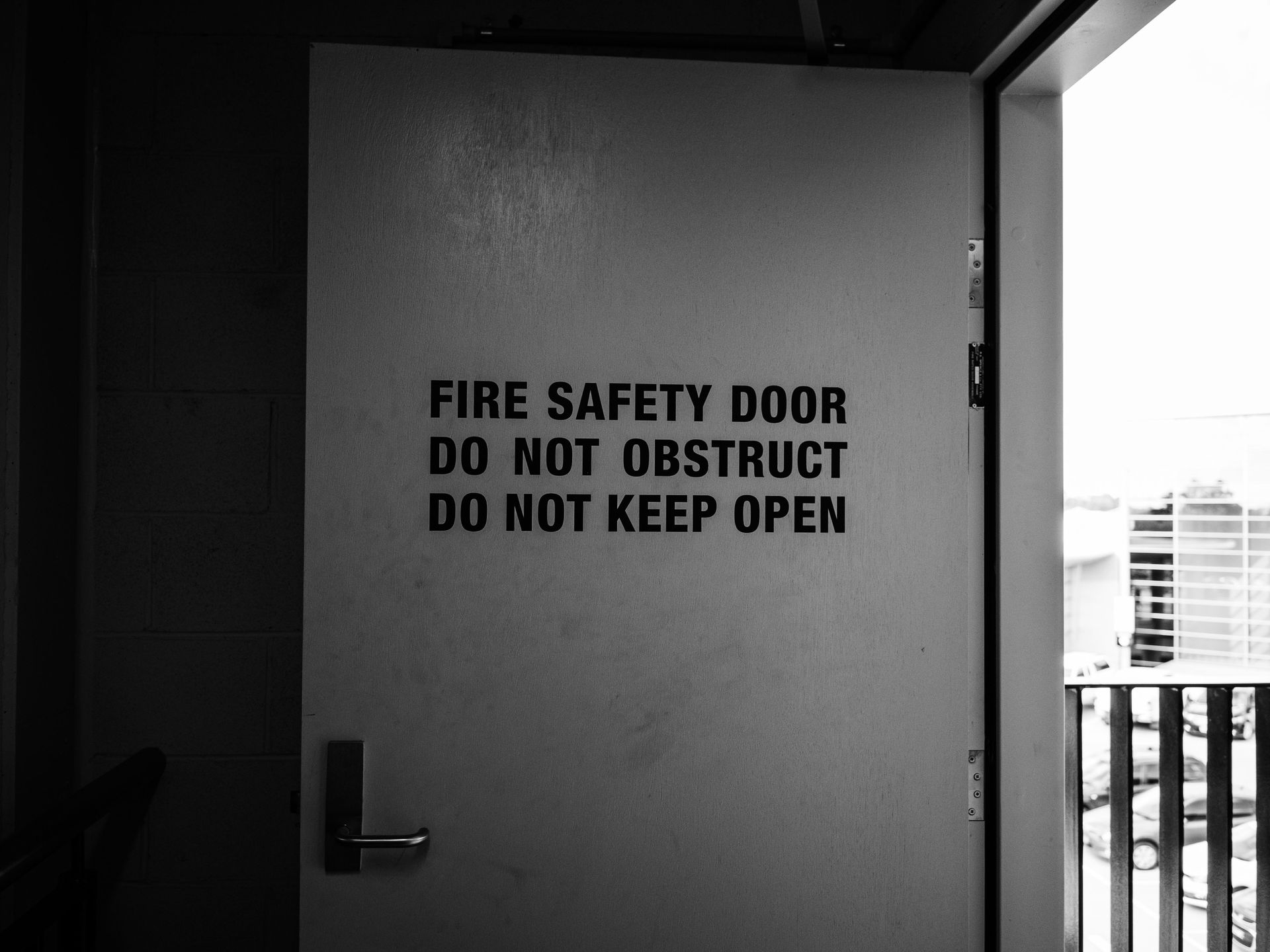
Picture of an open fire door.


Approved Document B is in two parts. Volume one covers dwellings, while volume two covers buildings other than dwellings.

We'll focus on volume two here, since commercial glazing is our wheelhouse.

The required fire resistance depends on where the door is used

This is crucial. Approved Document B doesn't specify a single, universal fire-door rating. Instead, it recommends minimum performance requirements for doors based on their position and function.


That means the requirements can differ based on factors like:

  • Whether the door is in a compartment wall
  • Whether it's part of a protected stairway
  • Whether it subdivides a corridor
  • Whether it provides access to an external escape route

To find the recommended performance rating for your particular door arrangement, refer to Table C1.


Fire resistance is specified in terms of integrity

Throughout Approved Document B, fire door performance requirements are expressed in terms of integrity (E). This refers to the time for which a fire door will protect against flames and hot gases, according to the European classification system.

For example:


  • E30: 30 minutes of fire protection
  • E60: 60 minutes of fire protection

The European system is roughly analogous to the older FD30/FD60 system, which came from the British Standard classification route. However, the FD standard is being phased out and will become illegal from September 2029.


Smoke control can be part of the requirement

Some fire door ratings include an additional 'Sa' classification. This denotes that the door must provide protection against smoke leakage at ambient temperatures, as well as fire integrity.


Fire doors generally need to be self-closing

Approved Document B states that most fire doors should be fitted with a self-closing device. There are limited exceptions to this specification, including cupboard doors and fire doors within flats and dwellinghouses.


The complete doorset matters

This is another crucial point.


You can't specify fire-rated glass in isolation. As Approved Document B makes clear, the complete door assembly – including glass, intumescent strips, door frames and ironmongery – must meet the relevant fire-performance rating.


If one of those elements isn't up to standard, you don't have a fire door. In the eyes of the law, you just have a common-or-garden, non-compliant door.


The door must be appropriately tested and classified

Approved Document B recommends routes for demonstrating fire performance through recognised testing and classification. These are:


  • BS 476-22: the British Standard for testing and classifying fire doors.
  • BS EN 1634 and BS EN 13501-2: the European testing procedure and classification framework, respectively.

As of 2026, BS 476-22 is being phased out. If you haven't already, it's important to familiarise yourself with the European system, which is replacing the British Standard.


How is Approved Document B changing in 2026?

From September 2026, Approved Document B will explicitly state that fire doorsets should be tested and classified according to European standards, not the older British Standard.


In September 2029, all references to the British Standard will be removed, and the European standard will become the only accepted framework for fire door classification.


How do fire door regulations differ in other parts of the UK?

Each of the four nations has its own building regulations framework and applicable fire safety guidance document. They differ in many ways – large and small.


Here's a quick guide to the most pertinent differences.


Nation Main building-regulations framework Fire safety guidance Key differences
England Building Regulations 2010 Approved Document B The backbone of fire safety regulations in England and Wales. All information above is pertinent to England.
Wales Building Regulations 2010 (as amended for Wales) Approved Document B (Welsh edition) Broadly similar to England. Some differences with higher-risk buildings and certain multi-occupancy dwellings.
Scotland Building (Scotland) Regulations 2004 Section 2 of the Scottish Technical Handbooks Entirely separate guidance and regulations framework. Underlying concepts are similar, but regulatory routes and terminology must be checked against Scottish requirements.
Northern Ireland Building Regulations (Northern Ireland) 2012 Technical Booklet E As with Scotland, Northern Ireland has its own guidance, regulations and regulatory routes. New and amended requirements introduced in May 2025.

Building regulations vs fire safety legislation

It's important to note that building regulations are a separate issue from fire safety legislation:


  • The Building Regulations (and Approved Document B) are primarily concerned with the design and construction of a building. That includes the fire performance of doors and other elements.
  • Fire safety legislation imposes ongoing duties to keep fire safety measures in efficient working order and good repair.

In England, fire safety legislation is laid out in two key documents: the Regulatory Reform (Fire Safety) Order 2005 and the Fire Safety (England) Regulations 2022.


How Wrightstyle can help

At Wrightstyle, we provide complete fire-rated glass door systems that are tested and classified to European standards.


Our 60F1 series includes glazed doors, windows and partitions built from high-performance steel and rated up to EI160 for integrity and insulation.

You tell us the performance rating you need, and we'll get you a glazing system to match.


Whether you want to request a quote, discuss your project or just ask a few questions, don't hesitate to get in touch with our experts. Whatever your requirements, we're ready to help.


Share this article

Recent Posts

Does your building project need anti-bandit, blast or ballistic glass? Explore your options
by Simon Edward 17 August 2026
Does your building project need anti-bandit, blast or ballistic glass? Explore your options in our industry guide.
Are you looking for a glazing system for an office fit-out? Explore key use cases
by Simon Edward 14 August 2026
Are you looking for a glazing system for an office fit-out? Explore key use cases and learn what you need to know before you specify.
At Wrightstyle, we specialise in large-span glazing. Find out how
by Simon Edward 10 August 2026
At Wrightstyle, we specialise in large-span glazing. Find out how we achieve large unassisted spans and why we always use steel, not aluminium.
How do the latest regulations in high-rise fire safety apply to glazing? Find out
by Simon Edward 7 August 2026
How do the latest regulations in high-rise fire safety apply to glazing? Find out in our industry guide.
Are you looking to make your procurement process cheaper, faster and safer? Find out how
by Simon Edward 4 August 2026
Are you looking to make your procurement process cheaper, faster and safer? Find out how high-quality tech support can help.
What do you need to know before specifying fire-rated doors with glass panels?
by Simon Edward 3 August 2026
What do you need to know before specifying fire-rated doors with glass panels? Learn about key regulations, fire ratings and what your options are.
How does soundproof glazing help reduce noise? Learn about this practical and versatile product
by Simon Edward 31 July 2026
How does soundproof glazing help reduce noise? Learn about this practical and versatile product and how it works.
You need specialist glazing to make shopping malls compliant with fire safety regulations.
by Simon Edward 24 July 2026
You need specialist glazing to make shopping malls compliant with fire safety regulations. Learn about compliance standards and glazing ratings.
What is blast-resistant glazing and how does it protect buildings from explosions? Get the facts
by Simon Edward 17 July 2026
What is blast-resistant glazing and how does it protect buildings from explosions? Get the facts in our glazing guide.
How does Approved Document B support fire safety in glazing installations? Find out
by Simon Edward 13 July 2026
How does Approved Document B support fire safety in glazing installations? Find out in our industry guide.
Show More